2-1) CA1 정리
Chapter 2: Instructions - Language of the Computer▶중간고사 기출문제 풀이
▶2019
- 1. What is the final value of $s
- (a)
assemblyaddi $s2, $0, 9 --> 9- (b)
assemblyaddi $t0, $0, 3 sll $2, $t0, 3 # sll 3 == 2의 3승 배 --> 24- (c)
assemblyaddi $t0, $0, 12 addi $t1, $0, 9 xor $s2, $t0, $t1 # 1100 ^ 1001 == 0101 --> 5- (d)
assemblyaddi $t0, $0, -2 addi $t1, $0, -1 nor $s2, $t0, $t1 # 11111...111 nor 11111...110 --> 00000...000 == 0- (e)
assemblyaddi $t0, $0, 3 addi $t1, $0, 3 slt $s2, $t0, $t1 # 같으므로(작지 않으므로) $s2에 0 저장 bne $s2, $0, ELSE # 0은 0과 같으므로 통과 nop j DONE # DONE으로 분기 nop ELSE: addi $s2, $s2, 2 DONE: addi $s2, $s2, 1 --> 1- (f)
assemblyaddi $t1, $0, 100 addi $s2, $0, 0 LO: slt $t2, $0, $t1 # 99부터 1까지 모두 더하기 beq $t2, $0, DONE nop addi $t1, $t1, -1 addi $s2, $s2, $t1 j LO nop DONE: --> 4950
- 2. Translate MIPS assembly code from C code. Assume that f=$1, g=$2, h=$3, i=$4.
- (a) f = g – h;
assemblysub $1, $2, $3- (b) f = (g+h)-(f+i)
assemblyadd $7, $2, $3 add $8, $1, $4 sub $1, $7, $8- (c) f = 3 << 4
assemblyaddi $7, $0, 3 sll $1, $7, 4- (d) f = g*h-3
assemblymul $5, $2, $3 addi $1, $5, -3- (e) if(i<5) i++; else i = -1;
assemblyslti $5, $4, 5 #if(i < 5) beq $5, $0, XXX nop addi $4, $4, 1 #i++ j EXIT nop XXX: addi $4, $0, -1 #i = -1 EXIT:- (f) int f(int a, int b) {
return f(a-1,b) + f(a, b-1);
}
assemblyaddi $sp, $sp, -16 sw $a0, 8($sp) sw $a1, 4($sp) sw $ra, 0($sp) addi $a0, $a0, -1 # a-1 jal f nop sw $v0, 12($sp) lw $a0, 8($sp) lw $a1, 4($sp) addi $a1, $a1, -1 #b-1 jal f nop lw $t0, 12($sp) add $v0, $t0, $v0 lw $ra, 0($sp) addi $sp, $sp, 16 jr $ra nop- (g) int fib(int n) {
if(n < 3) return n;
else return fib(n-1) + fib(n-2);
}
assemblyfib: addi $sp, $sp, -12 # 스택에 12 바이트 공간 할당 : n, fib(n-1), $ra 저장용 sw $a0, 0($sp) # 현재 n 값 스택에 저장 sw $ra, 8($sp) # 현재 복귀 주소 스택에 저장 slti $t0, $a0, 3 # n<3 --> $t0 = 1 --> return n beq $t0, $0, EL # n>=3 --> $t0 = 0 --> ELSE nop add $a0, $0, $a0 #return n j R nop EL: addi $a0, $a0, -1 # n-1 jal fib # fib(n-1) 재귀 호출 nop sw $v0, 4($sp) # fib(n-1)결과를 스택에 저장 lw $a0, 0($sp) # 원래 n 값 복원 addi $a0, $a0, -2 # n-2 jal fib # fib(n-2) 재귀 호출 nop lw $t0, 4($sp) # 스택에서 fib(n-1) 결과 복원 addi $v0, $t0, $v0 # fib(n-1) + fib(n-2) 계산후 $v0에 저장 R: lw $ra, 8($sp) # 복귀 주소 복원 addi $sp, $sp, 12 # 스택 포인터 원위치 jr $ra # 호출자로 복귀 nop- (h) int main() {
return fib(5); }
assemblymain: addi $sp, $sp, -4 # 스택에 4 바이트 공간 할당 sw $ra, 0($sp) # 메인 함수 복귀 주소 스택에 저장 addi $a0, $0, 5 jal fib # 피보나치 함수 호출 nop lw $ra, 0($sp) # 스택에 저장된 복귀 주소 꺼내기 addi $sp, $sp, 4 # 메인 함수 복귀 주소로 되돌리기 jr $ra # 메인 함수 종료 nop- (i) void numncpy(int* x, int* y, int n) {
for(int i = 0 ; y[i] ≠ 0, i++) {
}
assembly_numncpy: # int* x = $a0, * y = $a1, n = $a2, i = $t0 addi $t0, $0, 0 # x[i] = $t4, y[i] = $t3 Loop: add $t3, $a1, $t0 # y의 첫번째 칸에 접근 lw $t1, 0($t3) # y[i]의 값 불러오기 beq $t1, $0, EXIT # 불러온 값이 0이라면 탈출 nop add $t4, $a0, $t0 # sw $t1, 0($t4) addi $t0, $t0, 1 j Loop nop EXIT: jr $ra nop- (j) int f(int a, int b, int c, int d) {
return g(g(a+b, c), d)); }
assembly
▶2022
- 1.
- (a)
- 2.
- e)
javascriptif (i>=5) i++; else i=-1;javascript___ $5, $4, 5 ___ $5, $0, XXX nop addi ___, ___, 1 j EXIT nop XXX: ___ ___, ___, ___ EXIT:답
javascriptslti $5, $4, 5 bnq $5, $0, XXX nop addi $4, $0, 1 j EXIT nop XXX: addi $4, $0, -1 EXIT:- f)javascript
int f(int a, int b){ return f(1,2) + f(b,a);}javascriptf: addi $sp, $sp, sw $a0, 0($sp) sw $a1, sw $ra, addi , $0, 1 addi , $0, 2 jal f nop $v0, $a0, $a1, jal f nop $t0, add , $t0, lw $ra, addi $sp, $sp, jr $ra nop답
assemblyf: addi $sp, $sp, -16 sw $a0, 0($sp) # a sw $a1, 4($sp) # b sw $ra, 8($sp) addi $a0, $0, 1 addi $a1, $0, 2 jal f #return f(1,2) nop sw $v0, 12($sp) lw $a0, 4($sp) # b lw $a1, 0($sp) # a jal f #return f(b,a) nop lw $t0, 12($sp) add $v0, $t0, $v0 lw $ra, 8($sp) addi $sp, $sp, 16 - g)
피보나치 ㅇㅇ
- f)
- i) javascript
void numncpy(int* x, int* y, int n){
	for(int i=0;i<n;i++)
		x[i] = y[i];
}

_numncpy: addi $t0, $0, 0
Loop: slt $t1, $t0, ___
			___ $t1, $0, ___
			nop
			sll $t5, $0, ___
			___ ___, ___, ___
			lw ___, 0($t3)
			___ ___, ___, ___
			sw $t2, 0($t4)
			addi $t0, $t0, ___
			j Loop
			nop
EXIT:
답
assemblyvoid numncpy(int* x, int* y, int n){ for(int i=0;i<n;i++) x[i] = y[i]; } _numncpy: addi $t0, $0, 0 Loop: slt $t1, $t0, $a2 beq $t1, $0, EXIT nop sll $t5, $0, 2 #숫자는 x4 씩 add $t3, $a1, $t5 lw $t2, 0($t3) add $t4, $a0, $t5 sw $t2, 0($t4) addi $t0, $t0, 1 j Loop nop EXIT:
- 3. c 코드 mips로 바꾸기
- b)c
f(int a[10], int b[10]){
	a[2] = b[6];
}
답
assemblyf: lw $t0, 24($a1) sw $t0, 8($a0) jr $ra nop
- b)
- 4. (10pt) Compare the RISC and the CISC machine in terms of the number of instructions, the regularity of the instruction format, and the decoding logic for instructions. State which category MIPS, ARM, and x86 belong to, respective이거
- 5)
답
- (1): beq (2): sw, (3): 16($sp), (4): 20
- 스택을 그려라..?
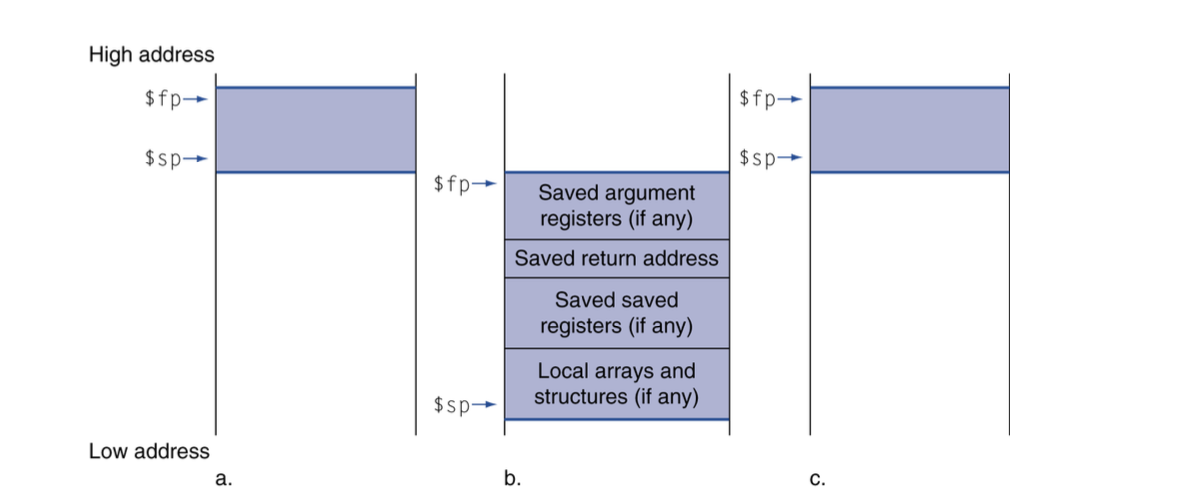
이거 박으면 되나
문제 골때리네
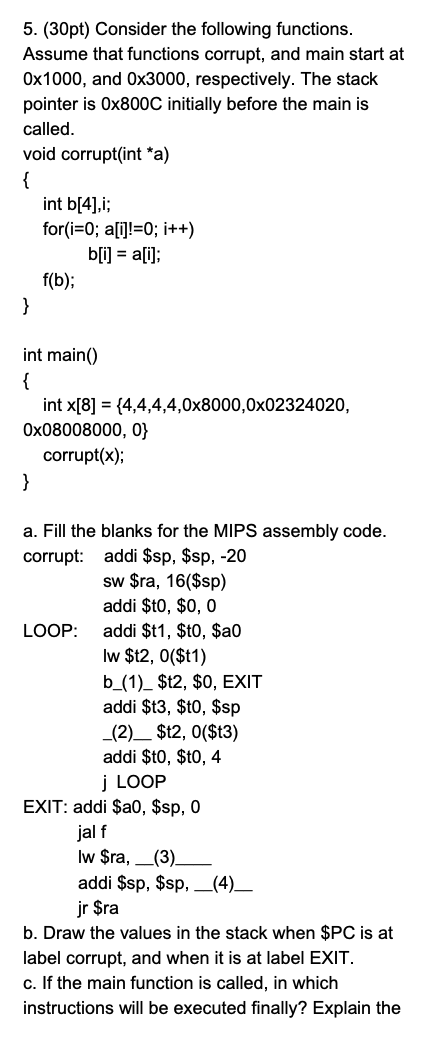
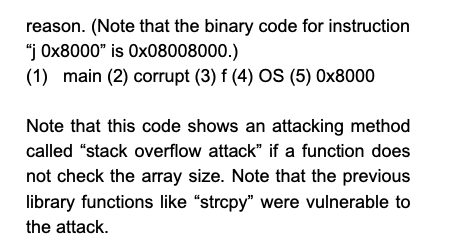
▶2024
- 1.
- 2. f= $1, g=$2, h=$3, i=$4.
- (d) if(i ≥ 5) i++; else i = -1;
assemblyslti $5, $4, 5 bne $5, $0, XXX nop addi $4, $4, 1 j EXIT nop XXX: addi $4, $0, -1 EXIT:- (e) int fib(int n) { if(n < 3) return 1; else return fib(n-1) + fib(n-2); }
assemblyfib: addi $sp, $sp, -12 sw $s0, 0($sp) sw $s1, 4($sp) sw $ra, 8($sp) slti $t0, $a0, 3 beq $t0, $0, EL nop addi $v0, $0, 1 j R nop EL: addi $s0, $a0, 0 addi $a0, $a0, -1 jal fib nop addi $s1, $v0, 0 addi $a0, $s0, -2 jal fib nop add $v0, $s1, $v0 R: lw $s0, 0($sp) lw $s1, 4($sp) lw $ra, 8($sp) addi $sp, $sp, 12 jr $ra nop- f int main() { return fib(5); }
assemblymain: addi $sp, $sp, -4 sw $ra, 0($sp) addi $a0, $0, 5 jal fib nop lw $ra, 0($sp) addi $sp, $sp, 4 jr $ra nop- (g)
assembly_strcpy: addi $t0, $0, 0 Loop: addi $t1, $a1, $t0 # t1 = &y[i] lb $t3, 0($t2) # t3 = y[i] addi $t2, $a0, $t0 # t2 = &x[i] sb $t3, 0($t2) # x[i] = t3 beq $t3, $0, EXIT # y[i] = 0이면 종료 nop addi $t0, $t0, 1 # i++ j Loop EXIT: - 3.assembly
reverse: # a0 는 문자열의 시작 포인터를 담고 있음 (0) addi $sp, $sp, -12 # 스택에 12바이트 공간 확보 sw $ra, 8($sp) # 복귀 주소 ra 저장 sw $s0, 4($sp) # s0 (앞 인덱스) 저장 sw $s1, 0($sp) # s1 (끝 인덱스) 저장 addi $s0, $zero, 0 # s0 = 문자열 시작 주소 addi $s1, $a0, $a1 # s1 = 문자열 끝 주소 subi $s1, $s1, 1 # s1을 문자열 끝 (널 뒤) 바로 전 문자 위치로 설정 loop: beq $s0, $s1, end # 앞 뒤 포인터가 만나면 종료 lb $t0, ($s0) # 앞쪽 문자 가져오기 lb $t1, ($s1) # 뒤쪽 문자 가져오기 sb $t1, ($s0) # 뒤쪽 문자를 앞쪽에 대입 sb $t0, ($s1) # 앞쪽 문자를 뒤쪽에 대입 addi $s0, $s0, 1 # 앞쪽 포인터 뒤로 이동 subi $s1, $s1, 1 # 뒤쪽 포인터 앞으로 이동 j loop nop end: lw $s0, 4($sp) # 레지스터 $s0 복원 lw $s1, 0($sp) # 레지스터 $s1 복원 lw $ra, 8($sp) # 복귀 주소 복원 addi $sp, $sp, 12 # 스택 포인터 원위치 복구 jr $ra nop - 4.assembly
is_even: addi $sp, $sp, -4 sw $ra, 0($sp) addi $t0, $a0, 0 andi $t0, $t0, 1 addi $v0, $zero, 1 # 기본값 v0 = 1 beq $t0, $zero, end # t0 = 0이면 짝수 addi $v0, $zero, 0 # 홀수면 0 end: lw $ra, 0($sp) # 복귀 주소 복원 addi $sp, $sp, 4 # 스택 포인터 복구 jr $ra # 호출 복귀 nop - 5. (20pt) Consider two different implementations of the same instruction set architecture. The instructions can be divided into four classes according to their CPI (class A, B, C, and D). P1 with a clock rate of 2 GHz and CPIs of 1, 2, 3, and 4, and P2 with a clock rate of 3 GHz and CPIs of 2, 2, 2, and 2. Given a program with a dynamic instruction count of 10⁶ instructions divided into classes as follows: 10% class A, 20% class B, 50% class C, and 20% class D, which implementation is faster?
- a. What is the global CPI for each implementation?
- b. Find the clock cycles required in both cases.
▶solution
- CPI global = sum of (kclass * kCPI)
P1 = 0.1 * 1 + 0.2 * 2 + 0.5 * 3 + 0.2 * 4 = 2.8
P2 = 0.1 * 2 + 0.2 * 2 + 0.5 * 2 + 0.2 * 2 = 2.0
- Clock Cycles = I * CPI global
P1 = 2.8 * 10^6 Cycles
P2 = 2.0 * 10^6 Cycles
P2 is faster because it has a lower global CPI, so it uses fewer cycles. Even with a higher clock rate, P2 completes the same instruction in less time.
- 6. (20 pt) Assume that the energy consumption of a processor core can be described by the equation Energy = 0.2 × s × V², where s is the execution time in seconds, and the operating voltage V is given by V = Frequency (in GHz). So at 1 GHz, V=1.0 V; if s=10 s then Energy=2 (=0.2×10×1²). If frequency=0 then V=0 and no energy is consumed. When program A runs at 1 GHz it takes 2 s.
- (1) If we run program A at 4 GHz, what voltage do we use and how much energy is consumed?
- (2) If V=0.5 V, what is the frequency and how much energy is consumed to finish program A?
▶solution
- 문제에서 A는 1GHz에서 2초가 걸린다고 되어있다. 만약 4GHz를 가한다면 A에 전압 4V가 들어가게 되고, 실행시간은 0.5초로 줄어들게 된다. 따라서 E는 0.2 * 0.5 * 16 = 1.6이 된다.
- 0.5V로 작동시킨다면 실행시간은 4초가 걸린다. 따라서 E는 0.2 * 4 * 0.25 = 0.2가 필요하다.
▶MIPS 레지스터 용도 정리
$t (temporary) — 임시값
$t0 ~ $t9(10개)- 함수 호출 시 보존 안 됨 (caller가 필요하면 직접 저장)
- 중간 계산, 조건 비교 등 짧게 쓸 때 사용
addi $t0, $0, 10 # 임시로 10 저장
slt $t1, $t0, $0 # 비교 결과 임시 저장$a (argument) — 함수 인자
$a0 ~ $a3(4개)- 함수 호출할 때 인자를 넘기는 용도
jal전에 세팅
addi $a0, $0, 5 # fib(5) 호출 전 인자 세팅
jal fib$s (saved) — 보존값
$s0 ~ $s7(8개)- 함수 호출 시 보존됨 (callee가 스택에 저장 후 복원해야 함)
- 재귀나 함수 간에 값을 유지해야 할 때 사용
sw $s0, 0($sp) # 함수 시작 시 저장
# ... 사용 ...
lw $s0, 0($sp) # 함수 끝에 복원$v (value) — 반환값
$v0 ~ $v1(2개)- 함수의 리턴값을 담는 용도
jr $ra전에 세팅
addi $v0, $0, 1 # return 1
jr $ra요약
- 값을 넘길 때 →
$a - 값을 받을 때 →
$v - 잠깐 계산할 때 →
$t - 함수 걸쳐서 유지할 때 →
$s
▶2025 midterm
- Note that
0x...denotes the hexadecimal number.
1. Value of $s1
(10pt) What is the value of $s1 after executing the following instruction sequences?
(a)
addi $s1, $0, 8
sll $s1, $s1, 2답
32(b)
addi $t0, $0, 10
addi $t1, $0, 3
and $s1, $t0, $t1답
2(c)
addi $t0, $0, -5
sub $s1, $0, $t0답
5(d)
addi $t0, $0, 3
sll $s1, $t0, 2답
12(e)
addi $t0, $0, 2
addi $s1, $0, 0
LOOP: slt $t2, $0, $t0
beq $t2, $0, DONE
addi $t0, $t0, -1
addi $s1, $s1, $t0
j LOOP
DONE:답
12. Translate MIPS assembly code from C code
Assume $1 = x, $2 = y, $3 = z, $4 = w.
(a) (3pt)
x = y + z;답
add $1, $2, $3(b) (3pt)
x = (y + z) << 2;답
add $2, $2, $3
sll $1, $2, 2(c) (4pt)
x = ~(y & z);답
and $5, $2, $3
nor $1, $5, $5(d) (5pt)
if(w < 0) w = 0;답
slt $5, $4, $0
beq $5, $0, EXIT
nop
addi $4, $0, 0
EXIT:(e) (17pt)
int fib(int n) {
if(n < 3) return 1;
else return fib(n-1) + fib(n-2);
}fib: addi $sp,$sp,____
sw $s0, ____
sw $s1, ____
sw $ra, ____
slti $t0, $a0, ____
___ $t0, $0, EL
addi ___,$0,1
j R
EL: addi $s0, $a0, 0
addi ____, $a0, ____
jal fibo
addi $s1, ___, 0
addi ____, $s0, ____
jal fibo
add $v0, ___, $v0
R: lw $s0, ______
lw $s1, ______
lw $ra, ______
addi $sp, $sp, _____
jr $ra답
fib: addi $sp,$sp,-12
sw $s0, 0($sp)
sw $s1, 4($sp)
sw $ra, 8($sp)
slti $t0, $a0, 3
beq $t0, $0, EL
addi $v0,$0,1
j R
EL: addi $s0, $a0, 0
addi $a0, $a0, -1
jal fib
addi $s1, $v0, 0
addi $a0, $s0, -2
jal fib
add $v0, $s1, $v0
R: lw $s0, 0($sp)
lw $s1, 4($sp)
lw $ra, 8($sp)
addi $sp, $sp, 12
jr $ra(f) (7pt)
int main() {
return fib(5);
}main: addi $sp, $sp, -4
sw ___, _____
addi _____, $0, _____
jal fib
lw ____, _____
addi $sp, $sp, _____
jr $ra답
main: addi $sp, $sp, -4
sw $ra, 0($sp)
addi $a0, $0, 5
jal fib
lw $ra, 0($sp)
addi $sp, $sp, 4
jr $ra(g) (6pt)
void strcpy(char* x, char* y) {
int i=0;
while((x[i] = y[i])!=0) I++;
}_strcpy: addi $t0, $0, 0
Loop: addi $t1, ____, $t0
lb ____, 0($t1)
addi $t2, ____, $t0
sb $t3, _____
b__ $t3, $0, EXIT
addi $t0, $t0, _____
j Loop
EXIT:답
_strcpy:
addi $t0, $0, 0 # i = 0 (인덱스)
Loop:
addi $t1, $a1, $t0 # $t1 = src + i
lb $t3, 0($t1) # $t3 = src[i]
addi $t2, $a0, $t0 # $t2 = dst + i
sb $t3, 0($t2) # dst[i] = src[i]
beq $t3, $0, EXIT # src[i] == '\0' 이면 종료
addi $t0, $t0, 1 # i++
j Loop
EXIT:4. is_even(n)
(8pt) Write MIPS assembly code for a function is_even(n) that takes an integer n and returns 1 if n is even, or 0 otherwise.
is_even:
addi $sp, $sp, ___
sw $ra, ___($sp)
addi $t0, $a0, ___
andi $t0, $t0, ___
addi $v0, $zero, ___
beq $t0, $zero, end
addi $v0, $zero, ___
end:
lw $ra, ___($sp)
addi $sp, $sp, ___
jr $ra답
is_even:
addi $sp, $sp, -4
sw $ra, 0($sp)
addi $t0, $a0, 0
andi $t0, $t0, 1
addi $v0, $zero, 1
beq $t0, $zero, end
addi $v0, $zero, 0
end:
lw $ra, 0($sp)
addi $sp, $sp, 4
jr $ra5. Processor comparison
(15pt) Two processors execute the same instruction set.
P1:2.5GHzclock, CPIs =1 (A), 3 (B), 2 (C), 5 (D)P2:2GHzclock, CPIs =2 (A), 2 (B), 2 (C), 2 (D)
Dynamic instruction count: 2 × 10^6
- 20% A
- 30% B
- 30% C
- 20% D
Questions:
- (a) What is the global CPI for each processor?
- (b) How many clock cycles are needed?
- (c) Which processor is faster?
답
(b)
(c)
6. Dynamic energy consumption
(20pt) The dynamic energy consumption of a processor is given by:
Energy = 0.5 × s × V^2where s is time (seconds), and voltage is:
V = 0.5 + 0.5 × Frequencywith frequency in GHz.
Given: program B takes 3 seconds at 1GHz.
(a) How much energy is consumed at 1GHz?
(b) If we run program B at 3GHz, how much voltage must be supplied, and how much energy will be consumed?
답
(b)
7. RISC vs CISC
(10pt) Compare the RISC and the CISC machine in terms of:
- the number of instructions
- the regularity of the instruction format
- the decoding logic for instructions
Also state which category the following belong to:
- MIPS
- ARM
- x86
답
▶2024 midterm
- Note that
0x...denotes the hexadecimal number. - Use the following operations:
add, addi, sub, mul, div, slt, slti, and, or, nor, xor, sll, srl, sra, andi, ori, nori, xori, nop, lw, sw, beq, bne, j, jr, jal
- Use the following registers:
$a0, $a1, $a2, $a3, $v0, $v1, $ra, $sp, $pc, ...$0, $1, ..., $31
- Put
nopafterbeq,bne,j,jal, andjrinstructions.
1. Final value of $s2
Represent $s2 in hexadecimal or decimal format.
(a)
addi $s2, $0, 2답
2(b)
addi $t0, $0, 7
sll $s2, $t0, 1답
14(c)
addi $t0, $0, 5
addi $t1, $0, 6
xor $s2, $t0, $t1답
3(d)
addi $t0, $0, -9
nor $t1, $t0, $t0
addi $s2, $t1, 1답
9(e)
addi $t0, $0, 4
addi $t1, $0, 3
slt $s2, $t0, $t1
bne $s2, $0, ELSE
nop
j DONE
nop
ELSE: addi $s2, $s2, 2
DONE: addi $s2, $s2, 1답
1(f)
addi $t1, $0, 4
addi $s2, $0, 0
LO: slt $t2, $0, $t1
beq $t2, $0, DONE
nop
addi $t1, $t1, -1
addi $s2, $s2, $t1
j LO
nop
DONE:답
62. Translate MIPS assembly code from C code
Assume that f = $1, g = $2, h = $3, i = $4.
(a)
f = g + h;___ $1, $2, $3답
add $1, $2, $3(b)
f = (g+h) - (f+i);add $5, _____, _____
add $6, _____, _____
sub ____, _____, _____답
add $5, $2, $3
add $6, $1, $4
sub $1, $5, $6(c)
f = 1 << 3;addi $5, $0, _____
____ $1, ____, ___답
addi $5, $0, 1
sll $1, $5, 3(d)
if( i>=5 ) i++; else i = -1;___ $5 , $4 , 5
___ $5, $0, XXX
nop
addi ____, _____, 1
j EXIT
nop
XXX: ___ ____, _____, _____
EXIT:답
slti $5, $4, 5
bne $5, $0, XXX
nop
addi $4, $4, 1
j EXIT
nop
XXX: addi $4, $0, -1
EXIT:
(e)
int fib(int n) {
if(n < 3) return 1;
else return fib(n-1) + fib(n-2);
}fib: addi $sp,$sp,____
sw $s0, ____
sw $s1, ____
sw $ra, ____
slti $t0, $a0, ____
___ $t0, $0, EL
nop
addi ___,$0,1
j R
nop
EL: addi $s0, $a0, 0
addi ____, $a0, ____
jal fibo
nop
addi $s1, ___, 0
addi ____, $s0, ____
jal fibo
nop
add $v0, ___, $v0
R: lw $s0, ______
lw $s1, ______
lw $ra, ______
addi $sp, $sp, _____
jr $ra
nop답
fib: addi $sp,$sp, -12
sw $s0, 0($sp)
sw $s1, 4($sp)
sw $ra, 8($sp)
slti $t0, $a0, 3
beq $t0, $0, EL
nop
addi $v0, $0, 1
j R
nop
EL: addi $s0, $a0, 0
addi $a0, $a0, -1
jal fib
nop
addi $s1, $v0, 0
addi $a0, $s0, -2
jal fib
nop
add $v0, $s1, $v0
R: lw $s0, 0($sp)
lw $s1, 4($sp)
lw $ra, 8($sp)
addi $sp, $sp, 12
jr $ra
nop(f)
int main() {
return fib(5);
}main: addi $sp, $sp, -4
sw ___, _____
addi _____, $0, _____
jal fib
nop
lw ____, _____
addi $sp, $sp, _____
jr $ra
nop답
main:
	addi $sp, $sp, -4
	sw $ra, 0($sp)
	addi $a0, $0, 5
	jal fib
	nop

	lw $ra, 0($sp)
	addi $sp, $sp, 4
	jr $ra
	nop
(g)
void strcpy(char* x, char* y) {
int i=0;
while((x[i] = y[i])!=0)
i++;
}_strcpy: addi $t0, $0, 0
Loop: addi $t1, ____, $t0
lb ____, 0($t1)
addi $t2, ____, $t0
sb $t3, _____
b__ $t3, $0, EXIT
nop
addi $t0, $t0, _____
j Loop
nop
EXIT:답
_strcpy: addi $t0, $0, 0
Loop: addi $t1, $a1, $t0
lb $t3, 0($t1)
addi $t2, $a0, $t0
sb $t3, 0($t2)
beq $t3, $0, EXIT
nop
addi $t0, $t0, 1
j Loop
nop
EXIT:3. reverse(str)
Write MIPS assembly code for a function reverse(str) that takes a string str and reverses its contents in place.
reverse:
addi $sp, $sp, ___
sw $ra, ___($sp)
sw $s0, ___($sp)
sw $s1, ___($sp)
addi $s0, $zero, ___
addi $s1, $a0, ___
subi $s1, $s1, 1
loop:
beq $s0, $s1, end
lb $t0, ($s0)
lb $t1, ($s1)
sb $t1, ($s0)
sb $t0, ($s1)
addi $s0, $s0, ___
subi $s1, $s1, ___
j loop
nop
end:
lw $s0, ___($sp)
lw $s1, ___($sp)
lw $ra, ___($sp)
addi $sp, $sp, ___
jr $ra
nop답
reverse:
addi $sp, $sp, -12
sw $ra, 8($sp)
sw $s0, 4($sp)
sw $s1, 0($sp)
addi $s0, $zero, 0
addi $s1, $a0, $a1
subi $s1, $s1, 1
loop:
beq $s0, $s1, end
lb $t0, ($s0)
lb $t1, ($s1)
sb $t1, ($s0)
sb $t0, ($s1)
addi $s0, $s0, 1
subi $s1, $s1, 1
j loop
nop
end:
lw $s0, 4($sp)
lw $s1, 0($sp)
lw $ra, 8($sp)
addi $sp, $sp, 12
jr $ra
nop4. is_even(n)
Write MIPS assembly code for a function is_even(n) that takes an integer n and returns 1 if n is even, or 0 otherwise.
is_even:
  addi $sp, $sp, ___
  sw $ra, ___($sp)
  addi $t0, $a0, ___
  andi $t0, $t0, ___
  addi $v0, $zero, ___
  beq $t0, $zero, end
  addi $v0, $zero, ___
end:
  lw $ra, ___($sp)
  addi $sp, $sp, ___
  jr $ra
nop답
is_even:
  addi $sp, $sp, -4
  sw $ra, 0($sp)
  addi $t0, $a0, 0
  andi $t0, $t0, 1
  addi $v0, $zero, 1
  beq $t0, $zero, end
  addi $v0, $zero, 0
end:
  lw $ra, 0($sp)
  addi $sp, $sp, 4
  jr $ra
nop5. Processor implementation comparison
(20pt) Consider two different implementations of the same instruction set architecture.
P1: clock rate2 GHz, CPIs =1, 2, 3, 4P2: clock rate3 GHz, CPIs =2, 2, 2, 2
A program has a dynamic instruction count of 10^6 instructions divided as follows:
- 10% class A
- 20% class B
- 50% class C
- 20% class D
Questions:
- (a) What is the global CPI for each implementation?
답
💡P110% * 1 + 20% * 2 + 50% * 3 + 20% * 4 = 0.1 + 0.4 + 1.5 + 0.8 = 2.8 P2
2
- (b) Find the clock cycles required in both cases.
답
💡Instruction Count = 10^6P1
Clock Cycles = 10^6 * 2.8
P2
Clock Cycles = 10^6 * 2
- (c) Which implementation is faster?
답
💡P2
6. Energy consumption
(20pt) Assume that the energy consumption of a processor core can be described by:
Energy = 0.2 * s * V^2where s indicates the execution time in second, and the operation voltage is:
V = Frequencywith frequency measured in GHz.
Given that program A takes 2 second at 1 GHz:
- If we want to run program A on
4GHz, then what voltage do we provide, and how much energy does the processor consume?답
💡V = 41GHz에 2초이므로 4GHz 에서는 0.5초
E = 0.2 * 0.5 * 4^2 = 1.6
- If the voltage is
0.5, then what is the frequency and how much energy does the processor consume to finish program A?답
💡Frequency = 0.5GHzTime = 4초
E = 0.2 * 4 * 0.25
= 0.2
▶2023 midterm
2023 Spring
- Note that
0x...denotes the hexadecimal number. - Put
nopafterbeq,bne,j,jal, andjrinstructions.
1. sum(n)
(10pt) Write MIPS assembly code for a function sum(n) that takes an integer n and returns the sum of all integers from 1 to n.
sum:
  addi $sp, $sp, ___   # Adjust stack pointer
  sw $ra, ___($sp)     # Save return address
  addi $t0, $zero, ___ # Initialize $t0
  addi $t1, $zero, ___ # Initialize $t1
loop:
  ___ $t1, $t1, ___    # Update $t1
  addi $t0, $t0, ___   # Update $t0
  slt $t2, $t0, $a0    # Compare $t0 and $a0
  bne $t2, $zero, loop # Branch if not equal
  ___
  lw $ra, ___($sp)     # Restore return address
  addi $sp, $sp, ___   # Adjust stack pointer
  jr $ra
  nop
답
sum:
  addi $sp, $sp, -4   # Adjust stack pointer
  sw $ra, 0($sp)     # Save return address
  addi $t0, $zero, 0 # Initialize $t0
  addi $t1, $zero, 1 # Initialize $t1
loop:
  add $t1, $t1, t0     # Update $t1
  addi $t0, $t0, 1   # Update $t0
  slt $t2, $t0, $a0    # Compare $t0 and $a0
  bne $t2, $zero, loop # Branch if not equal
  nop
  lw $ra, 0($sp)     # Restore return address
  addi $sp, $sp, 4   # Adjust stack pointer
  jr $ra
  nop
2. max(a, b)
(10pt) Write MIPS assembly code for a function max(a, b) that takes two integers a and b and returns the larger value.
max:
  addi $sp, $sp, ___   # Adjust stack pointer
  sw $ra, ___($sp)     # Save return address
  sw $s0, ___($sp)     # Save $s0
  slt $t0, $a0, $a1    # Compare a0 and a1
  beq $t0, $zero, else # Branch if a0 >= a1
  add $s0, $a1, $zero
  j exit
  nop
else:
  add $s0, $a0, $zero
exit:
  lw $ra, ___($sp)     # Restore return address
  lw $s0, ___($sp)     # Restore $s0
  addi $sp, $sp, ___   # Adjust stack pointer
  jr $ra
  nop
답
max:
  addi $sp, $sp, -4   # Adjust stack pointer
  sw $ra, 0($sp)     # Save return address
  sw $s0, 4($sp)     # Save $s0
  slt $t0, $a0, $a1    # Compare a0 and a1
  beq $t0, $zero, else # Branch if a0 >= a1
  add $s0, $a1, $zero
  j exit
  nop
else:
  add $s0, $a0, $zero
exit:
  lw $ra, 4($sp)     # Restore return address
  lw $s0, 0($sp)     # Restore $s0
  addi $sp, $sp, 4   # Adjust stack pointer
  jr $ra
  nop
3. strlen(s)
(10pt) Write MIPS assembly code for a function strlen(s) that takes a string s and returns its length.
strlen:
  addi $sp, $sp, ___   # Adjust stack pointer
  sw $ra, ___($sp)     # Save return address
  sw $s0, ___($sp)     # Save $s0
  add $s0, $a0, $zero  # Copy s to $s0
loop:
  ___ $t0, 0($s0)      # Load byte from memory
  beq $t0, ___, exit   # Exit loop if byte is null
  ___ $s0, $s0, ___    # Increment pointer
  j loop               # Jump back to loop
  nop
exit:
  sub $v0, $s0, $a0    # Calculate length of string
  lw $ra, ___($sp)     # Restore return address
  lw $s0, ___($sp)     # Restore $s0
  addi $sp, $sp, ___   # Adjust stack pointer
  jr $ra               # Return
  nop
답
strlen:
  addi $sp, $sp, ___   # Adjust stack pointer
  sw $ra, ___($sp)     # Save return address
  sw $s0, ___($sp)     # Save $s0
  add $s0, $a0, $zero  # Copy s to $s0
loop:
  ___ $t0, 0($s0)      # Load byte from memory
  beq $t0, ___, exit   # Exit loop if byte is null
  ___ $s0, $s0, ___    # Increment pointer
  j loop               # Jump back to loop
  nop
exit:
  sub $v0, $s0, $a0    # Calculate length of string
  lw $ra, ___($sp)     # Restore return address
  lw $s0, ___($sp)     # Restore $s0
  addi $sp, $sp, ___   # Adjust stack pointer
  jr $ra               # Return
  nop
4. is_even(n)
(10pt) Write MIPS assembly code for a function is_even(n) that takes an integer n and returns 1 if n is even, or 0 otherwise.
is_even:
  addi $sp, $sp, ___   # Adjust stack pointer
  sw $ra, ___($sp)     # Save return address
  sw $s0, ___($sp)     # Save $s0
  andi $t0, $a0, ___   # Bitwise AND with 1
  beq $t0, ___, even   # Check if n is even
  nop
  addi $v0, $zero, ___ # n is odd, return 0
  j exit
  nop
even:
  addi $v0, $zero, ___ # n is even, return 1
exit:
  lw $ra, ___($sp)     # Restore return address
  lw $s0, ___($sp)     # Restore $s0
  addi $sp, $sp, ___   # Adjust stack pointer
  jr $ra               # Return
  nop
5. Final value of $s2
Represent $s2 in hexadecimal or decimal format.
(a) (2pt)
addi $s2, $0, 7(b) (2pt)
addi $t0, $0, 5
sll $s2, $t0, 2
(c) (2pt)
addi $t0, $0, 7
addi $t1, $0, 3
xor $s2, $t0, $t1
(d) (2pt)
addi $t0, $0, -1
addi $t1, $0, -3
nor $s2, $t0, $t1
(e) (6pt)
addi $t0, $0, 1
addi $t1, $0, 4
slt $s2, $t0, $t1
bne $s2, $0, ELSE
nop
j DONE
nop
ELSE: addi $s2, $s2, 4
DONE: addi $s2, $s2, 1
(f) (6pt)
addi $t1, $0, 5
addi $s2, $0, 0
LO: slt $t2, $0, $t1
beq $t2, $0, DONE
nop
addi $t1, $t1, -1
addi $s2, $s2, $t1
j LO
nop
DONE:
6. C to MIPS translation
(a) (10pt)
Fill the blanks.
int fib(int n) {
  if(n==0) return 0;
  else if (n==1) return 1;
  else return fib(n-1) + fib(n-2);
}fib: addi $sp,$sp,____(1)______
sw $s0, 0($sp)
sw $s1, 4($sp)
sw _(2)__, ___(3)_____
b_(4)_ $a0, $0, E1
addi _(5)__,$0,0
j R
nop
E1: addi $t0, $a0, -1
b_(6)_ $t0, $0, E2
addi _(7)__,$0,1
j R
nop
E2: add $s0, $a0,$0
addi $a0,$s0,-1
_(8)__ fib
add $s1, $v0, $0
addi $a0,$s0,__(9)__
_(10)__ fib
add _(11)_, $s1,$v0
R: lw _(12)__, 0($sp)
lw _(13)__, 4($sp)
lw _(14)__, 8($sp)
addi $sp, $sp, _(15)____
jr $ra
nop(b) (5pt)
Consider the following main function. Fill the blanks.
int main() {
  return fib(3);
}main: addi $sp, $sp, -4
sw _(1)_, 0($sp)
addi _(2)__, $0, _(3)__
jal fib
nop
lw _(4)__, 0($sp)
addi $sp, $sp, _(5)___
jr $ra
nop(c) (10pt)
Suppose that the addresses of labels main and fib in questions 7 and 8 are 0x1000 and 0x2000, respectively. Assume that jalstores $ra by $PC+8.
Draw the stack change when function fib is called and returned. Initially $sp is 0x8000.
7. Processor comparison
(10pt) Consider three different processors P1, P2, and P3 executing the same instruction set with the clock rates and CPIs given in the following table.
| Processor | Clock rate | CPI |
|---|---|---|
| P1 | 3GHz | 3 |
| P2 | 1GHz | 4 |
| P3 | 4GHz | 2 |
(a) Which processor has the highest performance?
(b) If each processor executes a program in 10 seconds, find the number of cycles and the number of instructions.
8. Energy consumption
(10pt) Assume that the energy consumption of a processor core can be described by:
Energy = 0.2 * s * V^2where s indicates the execution time in second, and the operation voltage of the processor is described by:
V = Frequencywith the frequency measured in GHz.
- At
1 GHz, the voltage is1.0V. - If
s = 10 seconds, thenEnergy = 2 (= 0.2 * 10 * 1 * 1). - If the frequency is
0, then no energy consumption is required sinceV = 0. - When program A is running on
1 GHz, it takes2 second.
(a) If we are running program A on 2GHz, then how much energy does the processor consume?
(b) If the voltage is 0.5, then what is the minimum frequency and how much energy does the processor consume to finish program A?